How to Use Qwen-Image-Layered GGUF in ComfyUI: Complete Installation and Usage Guide
Master automatic layer decomposition with GGUF quantization for consumer hardware
Image editing has traditionally required manual masking, complex selections, and hours of painstaking work in tools like Photoshop. What if you could automatically decompose any image into editable layers with a single click? That's exactly what Qwen-Image-Layered brings to ComfyUI.
Developed by Alibaba's Qwen team, Qwen-Image-Layered is a revolutionary AI model that automatically breaks down images into multiple independent RGBA layers. Each layer contains specific semantic components—backgrounds, foreground objects, text, and decorative elements—that can be edited independently without affecting other parts of the image.
The GGUF (GPT-Generated Unified Format) version makes this powerful technology accessible to users with limited GPU memory. In this comprehensive guide, you'll learn how to install and use Qwen-Image-Layered GGUF in ComfyUI, even if you're working with consumer-grade hardware.
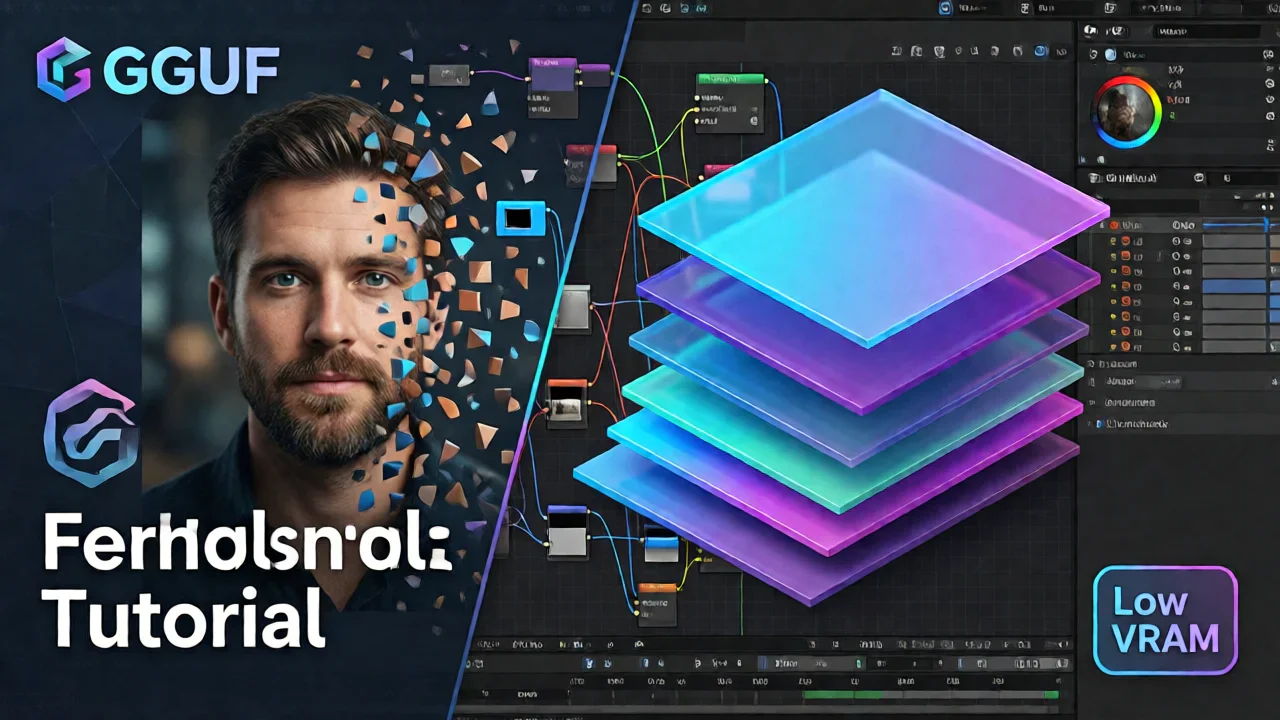
What is Qwen-Image-Layered?
Qwen-Image-Layered is an advanced image decomposition model that transforms flat raster images into structured, multi-layer representations. Unlike traditional image segmentation that only provides masks, this model generates complete RGBA images for each layer, including:
- Background layers with complete scene reconstruction
- Foreground objects with proper alpha channels
- Text elements isolated for easy editing
- Decorative effects and semi-transparent elements
- Occluded regions intelligently reconstructed
The model supports variable layer counts (3, 4, 8, or more) and even recursive decomposition, where any layer can be further broken down into sub-layers. This flexibility makes it suitable for everything from simple product photos to complex artistic compositions.
Why Choose GGUF Format for ComfyUI?
The GGUF format combined with quantization offers significant advantages for ComfyUI users, especially those working with limited hardware resources.
Key Benefits of GGUF Quantization
1. Dramatically Reduced VRAM Requirements
Quantization shrinks model size by 50-75% by reducing the precision of numerical weights. A model that typically requires 16GB+ VRAM can run on GPUs with 8GB or even less when using GGUF quantization. This democratizes access to advanced AI capabilities.
2. Faster Inference Times
Lower precision weights mean faster computations. GGUF's optimized binary format also enables quick loading and saving, reducing startup times and speeding up generation within ComfyUI workflows.
3. Cost-Effective AI Generation
By lowering hardware requirements, GGUF quantization eliminates the need for expensive high-end GPUs. You can run powerful image editing models on consumer-grade hardware, including laptops with integrated GPUs.
System Requirements and Prerequisites
Before installing Qwen-Image-Layered GGUF in ComfyUI, ensure your system meets these requirements:
Minimum Hardware Requirements
- GPU: 8GB VRAM (GGUF Q4 version) or 12GB+ VRAM (FP8/BF16 versions)
- RAM: 16GB system memory recommended
- Storage: 15-20GB free space for model files
- OS: Windows 10/11, Linux, or macOS
Software Prerequisites
- ComfyUI: Latest version (updated to support native Qwen-Image-Layered nodes)
- Python: 3.10 or newer
- CUDA: 11.8 or newer (for NVIDIA GPUs)
Step-by-Step Installation Guide
Follow these steps to install Qwen-Image-Layered GGUF in ComfyUI:
Step 1: Update ComfyUI
First, ensure you're running the latest version of ComfyUI:
cd ComfyUI
git pull
The latest ComfyUI versions include native support for Qwen-Image-Layered, eliminating the need for custom nodes in most cases.
Step 2: Download Required Model Files
You'll need three essential model files. Download them from Hugging Face or ModelScope:
Required Files:
- Text Encoder:
qwen_2.5_vl_7b_fp8_scaled.safetensors(~4.5GB) - Diffusion Model (choose one):
- GGUF Q4:
qwen_image_layered_Q4_K_M.gguf(~3.2GB) - Recommended for 8-12GB VRAM - FP8:
qwen_image_layered_fp8mixed.safetensors(~6.8GB) - For 12-16GB VRAM - BF16:
qwen_image_layered_bf16.safetensors(~13GB) - For 16GB+ VRAM
- GGUF Q4:
- VAE:
qwen_image_layered_vae.safetensors(~320MB)
Step 3: Place Files in Correct Directories
Organize the downloaded files in your ComfyUI installation:
ComfyUI/models/
├── text_encoders/
│   └── qwen_2.5_vl_7b_fp8_scaled.safetensors
├── diffusion_models/
│   └── qwen_image_layered_Q4_K_M.gguf
└── vae/
└── qwen_image_layered_vae.safetensorsImportant: The VAE file is specifically designed for Qwen-Image-Layered and handles four channels (RGBA) instead of the standard three (RGB). Don't substitute it with other VAE models.
Practical Use Cases and Applications
1. E-commerce Product Editing
Scenario: You have product photos that need color variations or background changes.
Workflow:
- Decompose product image into layers
- Isolate product layer from background
- Recolor product layer for different variants
- Replace background layer with new scenes
- Export variations for online store
Benefit: Create multiple product variants in minutes instead of hours of manual editing.
2. Marketing and Advertisement Creation
Scenario: Update promotional materials with new text or seasonal elements.
Workflow:
- Load existing advertisement image
- Decompose into layers (background, product, text, decorations)
- Replace text layer with updated copy
- Swap decorative elements for seasonal themes
- Maintain consistent lighting and composition
Benefit: Rapid iteration on marketing materials without starting from scratch.
Optimization Tips and Troubleshooting
Performance Optimization
1. Choose the Right Quantization Level
- Q4_K_M: Best balance for most users (3-4GB VRAM savings)
- Q5_K_M: Slightly better quality, moderate VRAM savings
- Q6_K: Near-original quality, minimal VRAM savings
2. Adjust Resolution Based on Hardware
Start with 640px and increase only if your hardware can handle it.
Common Issues and Solutions
Issue 1: "Out of Memory" Error
Solutions:
- Switch to lower quantization (Q4 instead of Q5/Q6)
- Reduce input resolution (640px instead of 1024px)
- Close other GPU-intensive applications
Issue 2: Poor Layer Separation Quality
Solutions:
- Increase inference steps to 60-70
- Adjust CFG scale (try 3.5-4.5 range)
- Provide descriptive prompt about image content
- Ensure you're using the correct Qwen VAE
Conclusion
Qwen-Image-Layered GGUF in ComfyUI represents a significant advancement in accessible AI-powered image editing. By automatically decomposing images into editable layers, it eliminates hours of manual masking work while maintaining professional-quality results.
Key Takeaways
- GGUF quantization reduces VRAM requirements by 50-75% without significant quality loss
- Q4_K_M quantization offers the best balance for most users with 8-12GB VRAM
- Native ComfyUI support simplifies installation and workflow creation
- Variable layer counts and recursive decomposition provide maximum flexibility
- Local processing ensures privacy, cost-effectiveness, and unlimited usage
Start experimenting with Qwen-Image-Layered GGUF in ComfyUI today, and discover how layer-based AI editing can transform your creative workflow.
Ready to try AI image generation? Visit ZImage.run to explore various AI models and workflows, or set up your local ComfyUI installation for unlimited creative possibilities.